
The SecOps / Incident Response Angle


Introduction
Modern application security starts at the edge—long before a request ever reaches an origin server. As threat actors automate reconnaissance, brute-force attempts, and Layer 7 DDoS attacks, security operations teams must rely on perimeter controls to inspect, filter, and mitigate malicious traffic at scale.
To gain hands-on visibility into edge security mechanisms, I built a dedicated live lab environment using a custom domain (experiement.xyz) routed through Cloudflare’s global Anycast network. This article breaks down the implementation of custom WAF rules, API-driven deployments, rate-limiting strategies, and the telemetry hidden inside edge response headers.
1. Architecture & DNS Setup
The core objective was to route all incoming domain traffic through an edge proxy, masking the origin server while enabling real-time packet and payload inspection.
[ Client / Automated Tool ]
           │
           ▼
[ Cloudflare Global Anycast Edge ] ── (WAF / Rate Limiting Rules Evaluated)
           │
           ├── (If Malicious/Exceeds Limit) ──> Block / Managed Challenge (HTTP 403 / 429)
           │
           ▼
[ Origin Server / Unreachable Target ]
Key Configuration
- DNS Records: A-records configured for
@andwwwpointed to a dummy origin IP (192.0.2.1, RFC 5737 TEST-NET-1). - Proxy Status: Enforced Proxied (Orange Cloud) mode across all records to ensure DNS queries resolve to Cloudflare's Anycast IPs rather than exposing raw origin infrastructure.
Key Takeaway: Traffic proxied at the edge never hits the origin IP directly. Layer 3/4 filtering and Layer 7 inspection occur seamlessly across Cloudflare's edge data centers worldwide.
2. Layer 7 Mitigation: Custom WAF Rules
Automated scripts and scrapers frequently rely on default user agents. To demonstrate Layer 7 mitigation, I configured a rule targeting command-line HTTP clients.
Rule Expression
(http.user_agent contains "curl")
- Action:
Managed Challenge - Scope: Applied globally across all incoming HTTP/HTTPS requests to
experiement.xyz.
Automating Deployments via the Cloudflare Rulesets API
In an active Incident Response (IR) scenario, UI-based rule creation can be too slow. Mitigations must be deployed programmatically across multiple zones using API calls:
curl -X POST \
  "https://api.cloudflare.com/client/v4/zones/${ZONE_ID}/rulesets/phases/http_request_firewall_custom/entrypoint/rules" \
  -H "Authorization: Bearer ${CF_AUTH_TOKEN}" \
  -H "Content-Type: application/json" \
  -d '{
    "rules": [
      {
        "action": "managed_challenge",
        "expression": "(http.user_agent contains \"curl\")",
        "description": "Emergency Mitigation: Block curl User-Agent"
      }
    ]
  }'
3. Validating Mitigation & Telemetry Analysis
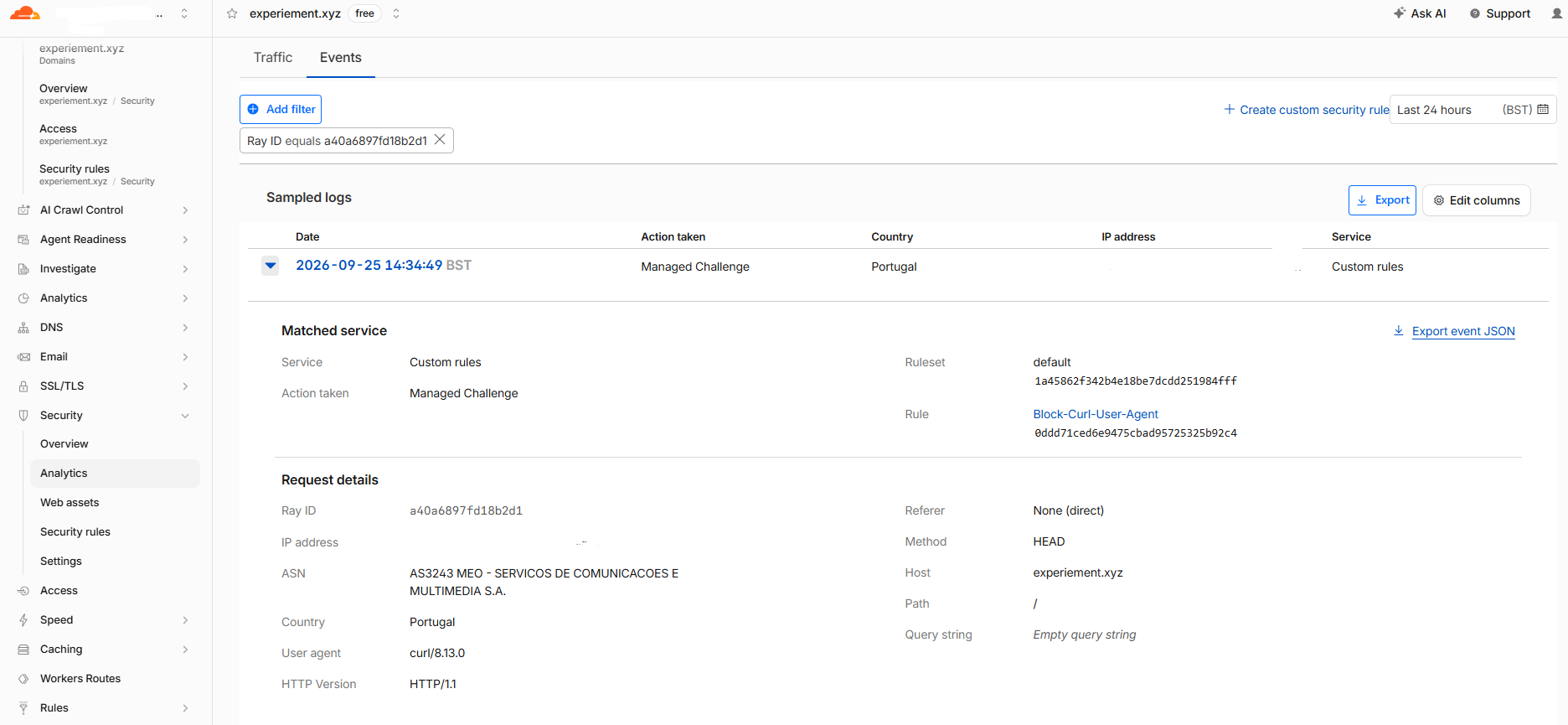
To test the WAF rule from a terminal, I executed an HTTP HEAD request using curl.exe:
curl.exe -I https://experiement.xyz
Raw Edge Response
HTTP/1.1 403 Forbidden
Date: Sat, 25 Sep 2026 14:34:49 GMT
Content-Type: text/html; charset=UTF-8
Connection: close
Cf-Mitigated: challenge
Server: cloudflare
Server-Timing: chlray;desc="a40a6897fd18b2d1"
CF-RAY: a40a6897fd18b2d1-LIS
Security Telemetry Breakdown
HTTP 403 Forbidden: The request was intercepted and denied at the perimeter before reaching any origin server.Cf-Mitigated: challenge: Explicit confirmation that an active edge security rule triggered a challenge page instead of serving raw content.CF-RAY: a40a6897fd18b2d1-LIS: Unique request trace ID. The-LISsuffix confirms the packet was evaluated and mitigated at the Lisbon, Portugal Point of Presence (PoP).
4. Rate Limiting & The Blast Radius Challenge
While hard blocking stops known malicious signatures, protecting endpoints like /login or /api/v1/search against brute-force attacks requires dynamic rate limiting.
Lab Configuration
- Target Path:
http.request.uri.path eq "/" - Threshold: 3 requests per 10 seconds per Source IP (
ip.src). - Action:
Block (429 Too Many Requests)for a duration of 10 seconds.
The CGNAT / Shared IP Dilemma in SecOps
When designing rate-limiting policies, security teams must account for Carrier-Grade NAT (CGNAT) and corporate egress IPs, where hundreds of legitimate users share a single public IP.
- Hard Blocking Risk: Setting aggressive limits (e.g., 20 req/min with a
Blockaction) can cause widespread collateral damage by locking out an entire corporate network. - Mitigation Strategy: Use Managed Challenge instead of hard blocking as the rate-limiting action. Real human users pass a background browser check seamlessly, while automated scripts are halted instantly.
5. Architectural Context: Layer 3/4 vs. Layer 7 Defense
Edge security requires a defense-in-depth approach operating across different OSI layers:
| L | Target Attack Vectors | Primary Edge Mitigation Mechanisms |
| L3 / L4 | SYN Floods, UDP Amplification, NTP Reflection | BGP Anycast (traffic absorption), BGP Flowspec (hardware router drops), eBPF/XDP (kernel-level driver drops), SYN Cookies. |
| L7 | Credential Stuffing, Scraping, HTTP Floods | WAF Rules, Rate Limiting, Managed Challenges (Turnstile), JA4 Fingerprinting. |
By terminating TCP/TLS connections at the edge, volumetric L3/L4 floods are dropped directly in hardware or driver space, preventing OS memory exhaustion on upstream servers.
Final Thoughts
Setting up this environment reinforced a core principle of modern SecOps: effective security relies on actionable telemetry and rapid, programmable mitigation. Understanding how edge proxies handle requests, evaluate rules, and append diagnostic headers allows incident response teams to diagnose attacks in real time and enforce controls at planetary scale.


